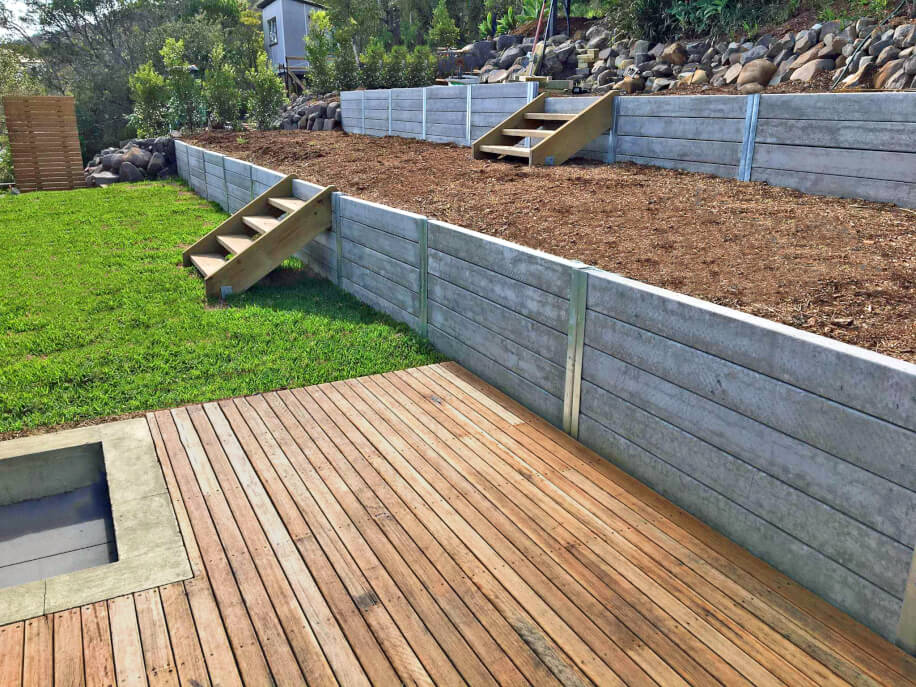
There’s a quiet shift happening in Victoria’s landscaping and construction industry. Homeowners, builders, and landscape architects are increasingly moving away from timber sleepers and concrete blocks—and choosing steel instead.
Not just for industrial or commercial applications. For residential retaining walls in backyards, driveways, and sloped blocks right across Victoria.
For decades, treated pine sleepers and concrete were the go-to choices for retaining walls. But those materials come with real limitations. Steel—particularly galvanised steel retaining wall posts—is quietly proving it’s the better option for most projects.
Is timber still the best choice? Or is there something stronger, straighter, and more durable?
Let’s look at why more Victorian homeowners are choosing steel retaining wall posts—and why that trend is likely here to stay.
The Timber Sleeper Problem You Didn’t Know About
Don’t get me wrong. Timber sleepers have served Victorian homeowners well. They’re familiar, relatively affordable, and landscapers know how to work with them. But timber retaining walls have some inherent challenges that are hard to ignore once you see them.
Timber moves. Wood is a natural product. It absorbs moisture from the soil, then dries out, then absorbs again. This constant cycle causes sleepers and posts to warp, twist, and shift over time. Those small movements add up—leaning walls, cracked footings, soil starting to push through.
Timber rots. Even treated pine breaks down eventually. Prolonged ground contact, moisture, and UV exposure all accelerate decay. A wall that looks fine at five years can start to fail at ten.
Timber is a buffet. Termites, borers, and other pests see your retaining wall posts as food. Treatments wear off, and some treatment chemicals raise environmental or health questions—especially near vegetable gardens or water features.
Timber burns. In bushfire-prone areas of Victoria, timber retaining structures are a genuine vulnerability. Steel doesn’t ignite. For homeowners in high-risk regions, that’s a serious advantage.
The Steel Difference
Steel retaining wall posts start with a completely different material philosophy. Steel is manufactured. It’s engineered. Every piece is consistent, predictable, and dimensionally true.
Here’s what that means for your retaining wall:
Structural integrity, long-term. Galvanised steel posts don’t rot, warp, or decay. A wall built with correctly sized steel posts—whether that’s 100UC, 150UC, 200UC, or 250UC sections—is designed to hold its shape and strength for decades, even in challenging soil conditions.
Pest resistance. Termites have no interest in steel. There are no chemical treatments to reapply, no annual inspections for borer activity, and no risk of a pest problem undermining your retaining structure.
Fire resistance. Steel is non-combustible. In Victoria’s bushfire zones, steel retaining wall posts provide a level of passive fire protection that timber simply cannot match.
Engineered to specification. Steel sections like Universal Columns (UCs) and H-channel posts are available in a range of sizes and load capacities. Unlike timber, where you’re working with a natural product of variable quality, steel sections are manufactured to tight tolerances. You know exactly what you’re getting.
Why Galvanised Steel Posts Matter
For retaining wall applications, galvanising is the critical step. Hot-dip galvanising coats the steel in a layer of zinc, creating a barrier against corrosion that’s designed to last in ground-contact conditions.
This matters because retaining wall posts are embedded in soil. They face moisture, clay, acids from organic matter, and variable drainage. A galvanised coating provides long-term protection in exactly these conditions.
Common galvanised steel profiles used in Victorian retaining walls include:
Galvanised H-channel posts – a versatile and popular choice that accepts concrete sleepers, timber sleepers, or steel infill panels.
Universal Column (UC) sections – including 100UC, 150UC, 200UC, and 250UC profiles. These provide significant lateral strength for walls that need to resist greater soil pressure or support heavier loads.
Universal Beam (UB) sections – such as 150UB, 200UB18, and 250UB25 profiles, used where longer spans or specific load requirements call for deeper sections.
The right section size depends on factors like wall height, soil type, surcharge loads, and post spacing. Getting the sizing right is important—undersizing a post in a high-load application is a structural risk.
The Sustainability Question
“But isn’t steel energy-intensive to produce?” Yes, it is. But the full picture is more nuanced.
Steel products typically contain a high percentage of recycled material. Scrap from demolished buildings, old vehicles, discarded appliances—all of it gets melted down and reborn as new steel sections and posts.
And at the end of your retaining wall’s long life, that steel can be recovered and recycled again. Timber sleepers from a demolished retaining wall? They often end up in landfill.
Steel construction also produces less on-site waste. Posts are cut to specified lengths, minimising offcuts and excess material.
Addressing the Common Concerns
“Isn’t steel more expensive?”
Upfront, steel posts often cost more than equivalent timber. But when you factor in longevity, no maintenance costs, no pest treatments, and no need to rebuild in ten years, the lifetime value equation changes substantially. A well-built steel retaining wall can outlast two or three timber ones.
“Doesn’t steel rust?”
Properly galvanised steel is highly resistant to corrosion, including in ground-contact applications. The zinc coating on hot-dip galvanised posts sacrifices itself gradually to protect the steel underneath—a process that takes decades before it becomes a concern.
“Is it harder to work with?”
Not at all. Steel H-channel posts and UC sections work with standard concrete sleepers, hardwood sleepers, and steel infill panels. Most landscape builders in Victoria are familiar with them. The installation process is straightforward when you have the right sections and correct post sizing.
The Bottom Line for Homeowners
Choosing your retaining wall material is a decision that affects the next decade or two of your property. You don’t want to be rebuilding it in five years because timber rotted or posts shifted.
Steel retaining wall posts offer:
Long-term structural stability that holds regardless of moisture, soil movement, or seasonal conditions
Complete pest resistance with no chemical treatments required
Fire resistance that timber simply can’t match—important in Victoria’s bushfire zones
Engineered section sizes from H-channels through to 150UC, 200UC, and 250UC profiles for demanding applications
Sustainability through high recycled content and full future recyclability
The retaining walls we build today need to last for generations—through wet winters, dry summers, and everything Victoria’s climate throws at them.
Steel is quietly proving it’s up to the task.
Need steel posts for your retaining wall? RW Steel Victoria supplies galvanised steel retaining wall posts, UC sections, H-channel profiles, and steel sleepers to homeowners, builders, and landscapers across Victoria. Whether you’re planning a small garden wall or a major cut-and-fill project, we can help you select the right section for your application. Contact us or get a quote online.